Trauma-Informed Clinical Supervision & Consultation
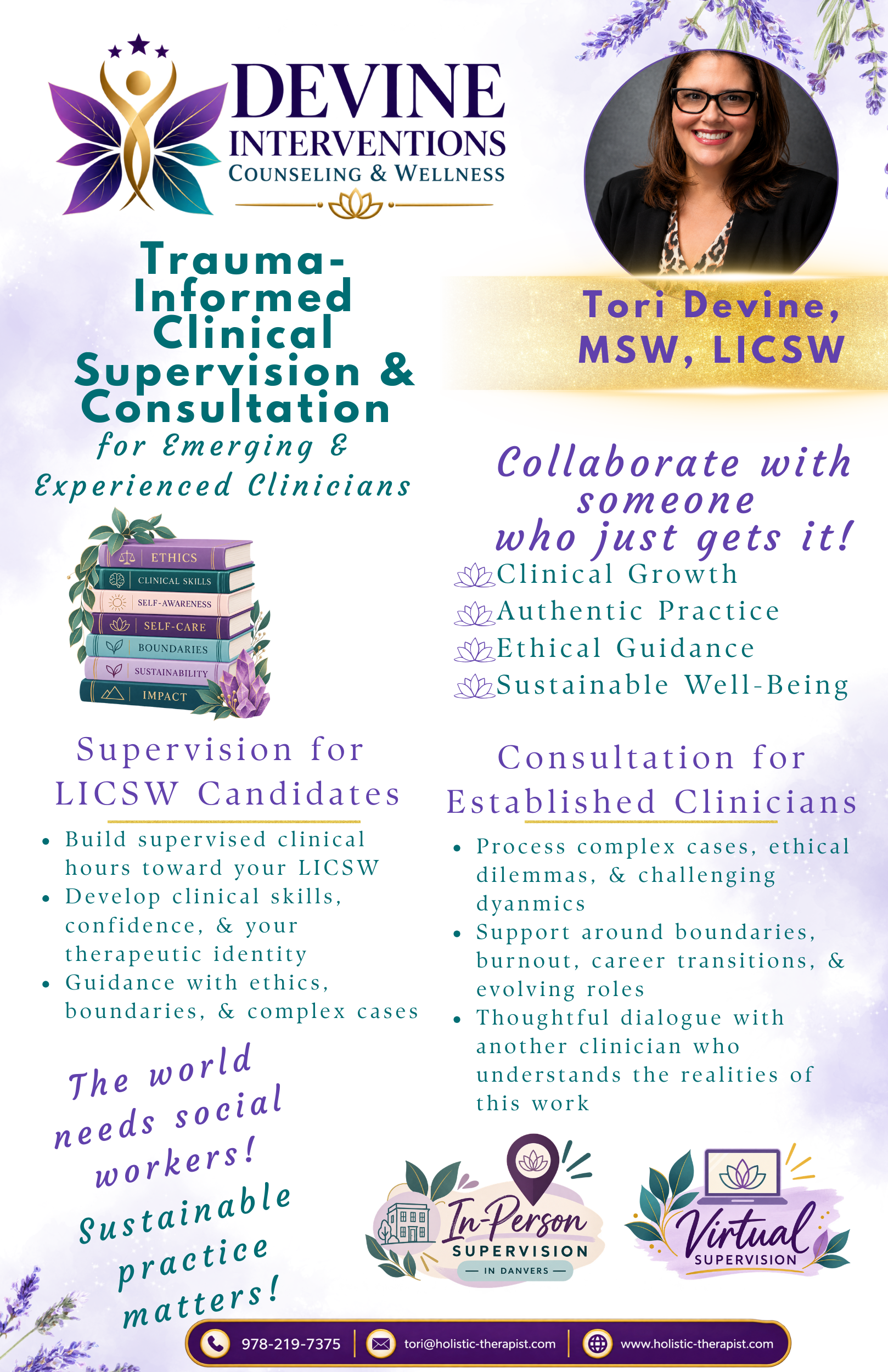
For emerging and experienced clinicians who want space to grow, reflect, ask the hard questions, and build a sustainable practice.
Clinical work asks a lot of us.
We hold stories, navigate complex relationships, make difficult clinical and ethical decisions, manage systems that don’t always make our jobs easy, and somehow try to take care of ourselves while doing work that asks us to care deeply about other people.
Good supervision should care about your impact on the field—and the field’s impact on you.
Whether you’re building your clinical identity as a newer social worker or you’ve been doing this work for years, you deserve a space where you can think out loud, ask questions, work through uncertainty, strengthen your skills, and show up as a human being—not just a clinician.
My approach to supervision and consultation is collaborative, trauma-informed, strengths-based, person-centered, and grounded in both ethical practice and clinician well-being.
Collaborate with someone who just gets it.
Supervision with me isn’t about pretending I have every answer or expecting you to practice exactly the way I do.
It’s a place to get curious together.
We can slow complicated situations down, explore different perspectives, think critically about clinical decisions, notice what may be happening in the therapeutic relationship, and talk openly about the parts of this work that don't always make it into textbooks.
Depending on what you need, our work might include:
Clinical growth • Authentic practice • Ethical guidance • Sustainable well-being
We can also make room for the human side of being a therapist: confidence, imposter feelings, boundaries, burnout, emotional reactions to the work, professional identity, career transitions, and figuring out how to do meaningful work without completely draining yourself in the process.
Supervision for LICSW Candidates
Build your clinical skills—and the kind of clinician you want to become.
If you’re working toward your LICSW, supervision can be much more than accumulating required hours.
This is an important stage of your professional development. You’re gaining experience, developing clinical judgment, discovering what approaches resonate with you, navigating situations that aren't always clear-cut, and beginning to develop your own therapeutic identity.
Supervision can give you space to:
Build supervised clinical hours toward your LICSW
Strengthen clinical skills, confidence, and clinical judgment
Develop your individual therapeutic style and professional identity
Conceptualize complex cases and explore different treatment approaches
Navigate ethics, boundaries, documentation, and challenging clinical situations
Explore transference, countertransference, and therapeutic dynamics
Think critically about culture, identity, power, privilege, and the systems affecting our clients
Talk openly about mistakes, uncertainty, and the inevitable “What the hell do I do with this?” moments of clinical work
Develop sustainable boundaries and practices that support longevity in the field
Celebrate your growth instead of only focusing on what you still have to learn
You don't need to arrive at supervision already knowing the answer.
That's kind of the point of supervision.
Questions, uncertainty, curiosity, and reflection are welcome here.
Consultation for Established Clinicians
Because experienced therapists need therapists to talk to, too.
Having experience doesn't mean you stop encountering difficult cases, ethical gray areas, complicated therapeutic dynamics, professional transitions, or moments when you simply want another clinician's perspective.
Sometimes you don't need formal supervision.
You need a thoughtful clinical colleague who gets the work.
Consultation can provide space to:
Process complex cases and challenging clinical dynamics
Think through ethical questions and professional dilemmas
Explore boundaries, burnout, compassion fatigue, and sustainability
Work through difficult therapeutic relationships
Discuss clinical approaches, interventions, and case conceptualization
Explore career transitions or evolving professional roles
Reflect on your clinical identity and how your work is changing
Talk through situations that feel stuck
Get another perspective without being told there is only one “right” way to practice
Have thoughtful conversation with another clinician who understands the realities of this work